In simple terms a broker is an intermediary that connects you to a market or a deal you cannot easily reach on your own. You want to buy or sell something. The broker has access to the venue or counterparties where that trade can happen, plus the systems and licences that make it possible.
In markets like equities, futures or listed options a broker is your legal and technical access point to the exchange. In forex and contracts for difference a broker often manufactures the instrument you trade and stands between you and other liquidity providers. In real estate or insurance the broker is more of a matchmaker and negotiator, helping you pick from offers and pushing paperwork through the system.
Two axes matter when you talk about types of brokers. One is trading model. That covers ideas like agency versus principal, market maker versus execution-only, dealing desk versus straight-through routing. The other axis is asset class. That is where you split stockbrokers, forex and CFD brokers, futures and options firms, crypto brokers, real-estate agents, mortgage and insurance brokers, and so on.
Once you see those two axes, marketing labels lose some of their magic. “ECN”, “DMA” or “full-service” become less about the slogan and more about concrete questions: whose risk book are you sitting on, who holds your assets, and how does the broker actually get paid.
Trading models: agency, principal and market making
Before worrying about assets, it helps to understand how a broker can sit in a trade.
An agency broker acts on your behalf and does not take the other side of your positions for its own book. It routes orders to an exchange or another dealer, tries to obtain a good price, and charges commission or a transparent fee. Classic stockbrokers and many futures firms work on this basis, especially for larger clients. In that model the broker focuses on execution quality and client service because that is what keeps order flow coming.
A principal broker deals against you. It sells you an instrument from its own inventory or takes the opposite side of your trade. Market making is the structured version of that. A market maker posts quotes to buy and sell and stands ready to fill trades at those quotes. In retail forex and CFDs many firms act as market makers. You buy EURUSD; they are short to you. You sell a CFD on an index; they are long to you. They can hedge externally or keep the risk in-house.
Between those poles you get hybrids. Many modern brokers run both agency and principal books. They internalise flow from some clients, hedge other trades out to banks or exchanges, and move accounts between these buckets based on behaviour. In forex circles this often gets described as routing to an A-book or a B-book.
Another split is execution-only versus advisory. Execution-only brokers take orders and process them. They may provide research and tools but they do not give personal recommendations. Advisory or full-service brokers add model portfolios, one-to-one advice, retirement planning and similar services. That extra attention costs money; you see it in higher commission, higher account minimums or embedded fees on assets under management.
For an active trader, the model tells you where conflicts sit. A broker that profits directly from client losses has different incentives than a broker that survives on commission spread across thousands of accounts. Neither model guarantees good or bad treatment, but the pressure on their risk team is not the same.
Equity and ETF brokers
Equity and ETF brokers connect you to stock exchanges and listing venues. You use them to buy and sell shares in companies, exchange-traded funds, sometimes listed notes and a handful of simple structured products. In many portfolios this is the “plain vanilla” broker relationship sitting alongside fancier trading accounts.
Full-service, discount and robo
Full-service firms bundle trading, advice and sometimes wealth management. You might have a named adviser, model portfolios, in-house research, access to new issues and corporate access events. Orders go through their desks or through white-label platforms. Fees are higher; in return you get personal contact and someone to call when something odd happens with a corporate action or tax form.
Discount brokers focus on low-cost execution through web and phone apps. Commission on share and ETF trades is often zero on the surface, especially in the US and parts of Europe. Income comes from payment for order flow, stock lending, foreign exchange markups, securities-based lending and interest on idle cash. For many swing traders and investors this model is enough; you get cheap access, decent tools and no adviser trying to sell you extra products.
Robo-brokers and robo-advisers bridge trading and asset management. You answer a questionnaire, they assign you to a risk band and invest your money into pre-built ETF baskets. Under the hood they function like a broker plus portfolio manager. You can usually override parts of the allocation, but the idea is “set, add, rebalance” rather than active stock picking. For someone who wants exposure without running individual positions, this is still a broker relationship, just less hands on.
Direct market access and active-trader firms
At the more specialised end you find equity brokers that stress direct market access. They provide order routing into multiple exchanges and dark pools, depth of book data, and detailed control over how orders rest and execute. Their clients are day traders, proprietary trading firms and active funds that care about slippage, rebates and microstructure.
These DMA firms may look similar to discount brokers on the surface but they tend to have richer order types, lower latency, higher data costs and more complicated fee schedules. Commissions might be lower per share but you pay for each routing decision and for every venue you connect to.
For an equity swing trader the sweet spot often sits between the extremes. You probably do not need every exotic order type that a prop desk uses, but you may want reliable market and limit orders, clean access to extended hours sessions, solid corporate action handling and honest forex conversion when you trade non-domestic names. The right broker is the one that does that consistently, not the one with the most logos on the homepage.
Forex and CFD brokers
Forex and CFD brokers handle trading in currency pairs and synthetic contracts on indices, commodities, shares and sometimes crypto prices. Here the broker’s role goes beyond routing; very often it manufactures the actual product you trade.
Market makers, STP and ECN
In retail forex a common model is the market maker or dealing desk. The broker quotes bid and ask prices, takes the other side of client trades and manages risk internally or with external hedges. Pricing can be smoothed compared with raw interbank quotes. Spreads may be fixed during calm periods. The broker’s income comes from spread markups and the net result of its risk book.
STP, or straight-through processing, brokers aim to send client orders straight to external liquidity providers without manual dealing desk intervention. They pull quotes from banks and non-bank dealers, aggregate them, add a small markup or a commission, and pass trades through. In theory client wins and losses are neutral for them because they hedge out risk; their focus is volume.
ECN brokers go a step closer to a pooled order book. They hook clients into an electronic network where banks, funds and other participants quote two-way prices. Spreads on liquid pairs can be very tight and commission is explicit. Some platforms show depth beyond the best bid and offer, which helps larger traders see where size rests.
In practice many brokers blend these models. They might run an ECN account tier for larger or more experienced clients, an STP feed for standard accounts, and a B-book dealing desk behind the scenes for very small or erratic flow. Marketing tags sometimes lag reality.
Regional rules and what they change
Regulation shapes how forex and CFD brokers can behave. In regions like the EU, UK, US and Australia, product intervention and retail protections cap position size multipliers, require clear risk warnings, and restrict bonuses tied to trading volume. Client funds often must be held in segregated accounts at recognised banks. Reporting and capital standards apply.
Brokers in these regions still choose between market maker, STP and ECN models, but their freedom to offer extreme margins or highly exotic products to small accounts is reduced. That tends to push them toward pushing volume rather than chasing one-off client losses.
Offshore brokers in lighter jurisdictions can advertise higher multipliers, thinner account checks and a wider range of contracts. Some are serious firms seeking flexibility. Others are thinly capitalised operations that see client deposits as the main prize. The same trading model label means very different things when the legal backdrop changes.
For a forex or CFD swing trader the model defines how spreads move during quiet and active times, how swaps are handled, who sits on the other side of the trade and what happens during stress. That matters more over a year of trading than any welcome bonus.
Futures and options brokers
Futures and listed options sit on organised exchanges with central clearing. Brokers in this space act as the gateway to that clearing system and to the exchange order books.
Clearing, margins and exchange access
When you trade a future or an option you enter a contract cleared through a central counterparty. Your broker is a clearing member or has a relationship with one. It collects initial and variation margin from you, passes it to the clearing chain and handles daily settlement of gains and losses.
Futures brokers focus on stable connectivity to exchanges, accurate margining and fast handling of collateral. They also manage risk by setting higher limits than the exchanges require, especially for smaller clients. They may offer different margin policies for day-trade positions and overnight holds.
Options brokers add complexity. They must support multi-leg strategies, assignment and exercise, and often portfolio margin systems that look at risk across positions. Tools like option chains, payoff diagrams and risk analytics become part of the brokerage service, even if they are delivered through third-party platforms.
Exchange coverage differs. Some brokers focus on US futures and options, others on European or Asian markets, others on a global set. Fees, data packages and minimum balances tend to be higher than in simple equity accounts because the infrastructure and risk capital needs are higher.
Who uses futures/options brokers
Futures brokers serve hedgers, speculators and arbitrageurs. Clients include commodity producers, trading houses, systematic funds and active individual traders. Options brokers overlap with that set but also serve equity investors who use options for income or hedging.
For a trader moving from CFDs to exchange-traded futures and options, the broker relationship feels more transparent in some ways and more demanding in others. Pricing comes straight from the exchange book, with commission on top. Margin calls and risk limits are enforced by systems that answer to clearing houses as well as to the broker’s own risk team. You lose some flexibility but gain a clearer rule book.
Crypto brokers and exchanges
Crypto trading blurred the line between broker and exchange. Many platforms act as both. You open an account, deposit coins or fiat, and trade directly on their centralised order books.
Centralised exchanges and broker wrappers
Centralised crypto exchanges aggregate buyers and sellers, match orders and hold client assets. They charge trading fees, listing fees and sometimes interest on margin products. In that sense they are both venue and broker.
On top of them you now find broker wrappers. These are apps, neobanks or investment platforms that let clients buy and sell a narrow range of coins without exposing them to the full exchange interface. The broker deals with the exchange or with liquidity providers, then updates an internal balance for the client. In some cases the client never gains on-chain withdrawal rights; what they hold is an IOU from the broker.
This model suits people who treat crypto as another line on a portfolio statement rather than something to move across wallets and protocols. The broker shields them from network fees, address management and similar details, in return for spreads, fees and sometimes stricter limits.
Derivatives, swaps and on-chain alternatives
Crypto brokers also offer derivatives: perpetual swaps, dated futures and options on coins. These products behave like high-volatility cousins of traditional futures and options. Some are listed on regulated venues, many sit on offshore platforms. Margin and liquidation rules are controlled by the exchange or broker.
Alongside centralised players you have on-chain alternatives in the form of decentralised exchanges and protocols. They use smart contracts and liquidity pools to let users trade tokens directly from wallets. In that world the “broker” is code rather than a company, though in practice you often still rely on interfaces, aggregators and data providers.
For someone already familiar with equities or futures, the key point is that crypto “broker type” is less standardised. One brand might be a fully regulated exchange with a broker front end. Another might be an overseas entity serving as both market maker and custodian with little oversight. The label alone does not tell you which one you are dealing with.
Other broker categories around money and assets
Not all brokers sit in front of quote screens. Some types are about matching long-term commitments rather than short-term trades, but the logic is similar: access plus expertise in a specific domain.
Real-estate, mortgage and insurance brokers
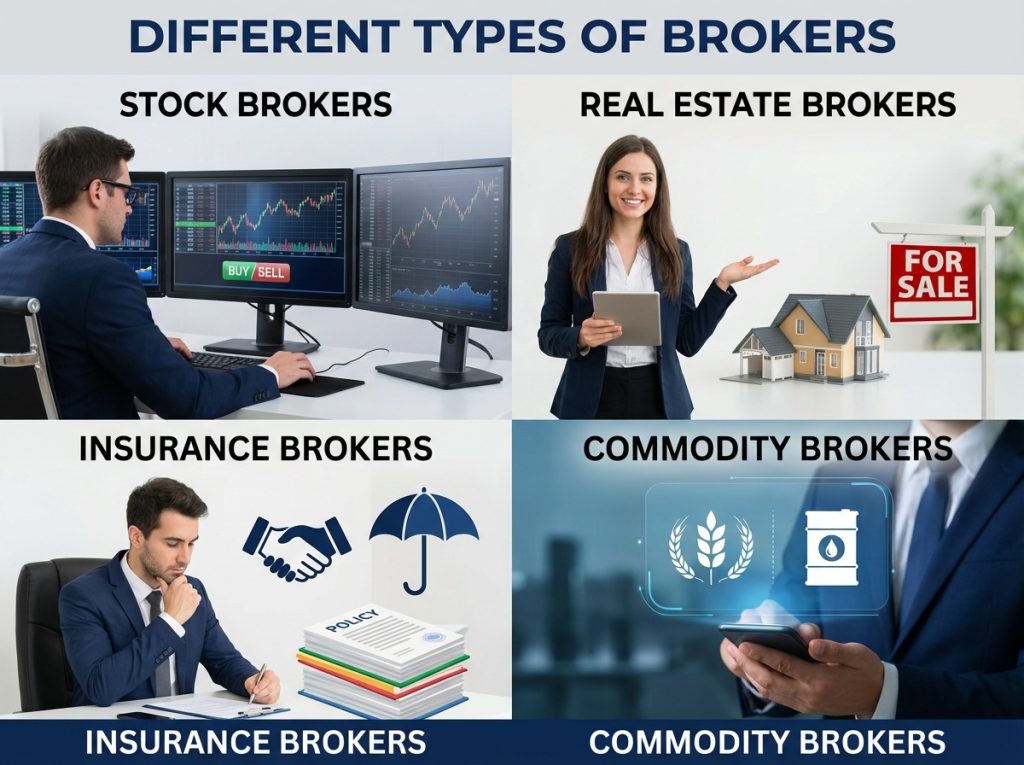
Real-estate brokers and agents connect buyers and sellers of property. They know local pricing, regulations and marketing channels. They earn commission when deals close. In some regions they represent one side only, in others they can act for both, which raises familiar conflict questions.
Mortgage brokers find home loans for buyers. They have relationships with banks and lenders and match client profiles to loan products. They are paid via lender commissions, client fees or both. The client benefits from comparison, at the cost of stepping through an extra intermediary.
These brokers deal in contracts and real assets rather than daily traded instruments, but the questions you ask are familiar. Who pays them. How independent is their advice. What happens if things go wrong and a claim or sale is disputed.
Introducing brokers and prop firms
Introducing brokers in trading refer clients to main brokers in return for a share of spread, commission or other fees. They add education, local language support or marketing, while the main broker handles execution and custody. This structure is common in forex and CFDs, sometimes in futures.
From a trader’s view, you hold an account with the main broker and have a relationship with the IB as well. That double layer can be useful if the IB genuinely adds education and support, or dangerous if it pushes clients toward over-trading to maximise referral revenue. Reading both sets of terms, not just the IB’s homepage, is worth the time.
Proprietary trading firms sit halfway between employer and broker. They provide access to capital, platforms and data. You trade under their rules, usually after an evaluation phase. Some firms internalise trades and pay you from fee revenue, others route a share of flow to external markets through partner brokers.
In both IB and prop setups, understanding who actually holds the account at the end of the chain matters. If there is a dispute over payouts or positions, you want a clear picture of the legal map, not just a logo and a marketing brand.
Matching broker and model to your trading and investing style
Once you know what types of assets you want to trade and which broker type is best for that type of asset, it becomes a lot easier to choose a broker.Below are a few examples to illustrate this.
Don’t turn investors into choosing a broker that gives them access to a lot of ETFs and stocks as well as mutual funds and other long-term low-risk financial instruments. You can find a broker that suits long-term investors by visiting Investing.co.uk. The website is focused on UK clients but the brokers they recommend are a good choice in most countries since brokers that are licensed by the FCA in the UK tend to be some of the best in the world.
A swing trader in forex or indices cares about spreads, swaps, execution behaviour during active times and how margin is handled across days. That shifts the choice toward forex and CFD brokers with transparent trading models, decent regulation and a track record of surviving market shocks without rewriting fills.
A futures or options trader needs solid exchange connectivity, robust margin systems and tools for structuring and analysing positions. A specialised futures and options broker that invests in platforms and data handles that better than a broker where derivatives are an afterthought bolted onto a share-trading app.
A crypto trader has to decide how much on-chain control they want. Someone who trades prices and never withdraws is choosing between centralised exchanges and broker wrappers, with regulation and solvency as key filters. Someone who wants to use protocols as well as trade spot and derivatives juggles both broker-style accounts and self-custody, with more moving parts to track.
Under all of those choices sits the trading model. Agency or principal, market making or pass-through, pure execution or heavy advice. Knowing which mix you are signing up for helps set expectations. You cannot remove every conflict or every risk, but you can avoid being surprised by how a broker acts, because you took the time to understand what kind of business sits behind the nice looking platform.